All Football
Get the app
Pochettino slams referees again: Barcola interfered with wall, Liverpool's opener should have been disallowed
Mauricio Pochettino and Man Utd have once again hit out at the officiating team over what happened at Anfield on November 22.
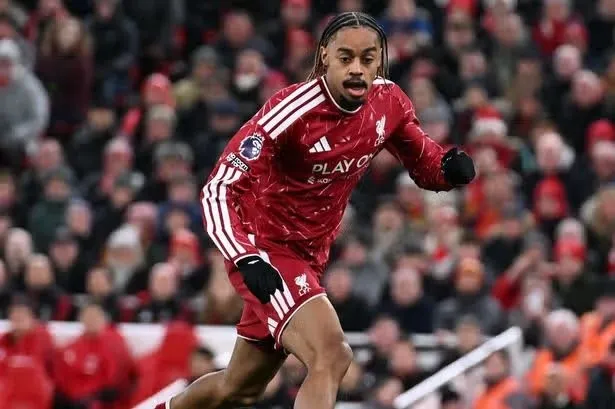
Following the heavy defeat at Anfield, Bradley Barcola has become the focus of Man Utd's latest complaint. Pochettino believes Liverpool's opening goal, scored shortly after Leny Yoro was sent off for a foul on Alexander Isak, should not have stood.
The new Man Utd boss argues that Barcola made physical contact with Man Utd's wall just before Dominik Szoboszlai scored from the free-kick. He said Bruno Fernandes had alerted referee Sam Barrott at the time and claimed VAR should have intervened.
Speaking to the media ahead of Man Utd's Champions League clash against Sporting CP, Pochettino said: "I don't think we noticed it at the time, but Bruno saw it, and that's why he's the captain, because he's smart and can sense and see what's happening on the pitch."
"Nobody is talking about whether that goal was legal. That goal should have been disallowed because Barcola touched our wall. Last season when Eberechi Eze scored against Crystal Palace [it was ruled out]. Why didn't they look at VAR, why didn't they check that goal? It had to be disallowed."
"I need to defend my players and my club. Where are the three points? We need to think more deeply about the way we use this technology."
"Now we need to move forward. I'm very proud of the players, proud of the way they handled all these unfair situations on the pitch. Our focus now is to improve, get better and start winning, and we have a great opportunity here tomorrow."
Pochettino also criticised VAR for failing to overturn Yoro's red card, claiming Man Utd were deprived of the chance to compete on equal terms with their opponents.
Before he voiced his frustration with the officials—particularly VAR John Brooks—Man Utd's hierarchy had privately hit out at Howard Webb and ProRef, who backed the decision to send Yoro off despite Man Utd successfully appealing the red card.
ProRef chief Webb subsequently said on Mic'd Up that the decision was "certainly not wrong" and praised the referee for being decisive. Webb's comments angered the Man Utd hierarchy after the club's successful appeal.
A club source confirmed to the Manchester Evening News that Man Utd will now raise the matter with the Premier League and ProRef, while Pochettino still sounded furious two days after the incident.
He said: "Very disappointed, because I think this kind of thing should never happen. My question is always the same. Okay, we can accept that referees make mistakes because of their emotional connection to the game, but if we have VAR, what are they doing?"
"Because are we going to replay the match now? Do we still have the chance to play 11 against 11 on equal terms? No, the problem is that we were on the pitch at that time, and at that moment I think we needed time to review what happened."
Further reading: The origin and enforcement of the one-metre wall rule for free-kicks. Ahead of the 2019-20 season, the International Football Association Board (IFAB) made an important revision to Law 13 (Free Kicks) of the Laws of the Game. Previously, attacking players often crowded into the defending wall during free-kicks to create gaps or block the goalkeeper's line of sight. This not only led to pushing and shoving, but also frequently delayed play and caused major headaches for referees. Under the revised law, when the defending team forms a "wall" of three or more players, all attacking players must remain at least one metre (one yard) away from the wall until the ball is in play. This distance restriction applies in all directions around the wall, and attackers must not interfere with the wall's positioning through physical contact or standing right up against it. If the referee sees an attacking player within one metre of a wall of three or more players when the free-kick is taken, the laws clearly state that an indirect free-kick should be awarded to the defending team. This means the attacking side not only loses a dangerous set-piece opportunity, but possession is immediately turned over. When the Premier League introduced this rule in 2019, it noted that banning attackers from "mixing" into the wall would help speed up the game and uphold the spirit of fair play. Since then, this "one-metre exclusion zone" has become the standard basis for officiating free-kick positioning in professional football worldwide.
 Premier League standings
 Liverpool live stream & scores



 Man Utd were supposed to be destroyed